Nous comparons deux encodeurs pré-entraînés sur le français :
CamemBERT-base (architecture RoBERTa)
CamemBERTa-base (architecture DeBERTa-v2)
Les modèles sont fine-tunés avec LoRA (Low-Rank Adaptation) pour une efficacité paramétrique optimale.
CamemBERT et CamemBERTa
Présentation des modèles
Les modèles CamemBERT et CamemBERTa sont deux modèles de type encoder-only, ils créent donc des représentations vectorielles de séquences de mots en prenant en compte leur contexte. Ces représentations peuvent ensuite être utilisées pour des tâches comme la classification ou l’inférence, comme dans notre cas.
Cependant, bien que leur structure soit similaire, ces deux modèles possèdent des différences importantes à prendre en compte.
Différences architecturales
CamemBERT, basé sur RoBERTa (2019), additionne les vecteurs d’embeddings avec les vecteurs de position dès le début du traitement :
Cette approche crée une position absolue pour chaque mot (position 0, 1, 2, ...). Le calcul de l’attention se fait ensuite de manière standard :
où , , sont calculés à partir de l’input combiné (contenu + position). Le problème est que le contenu sémantique et l’information de position sont mélangés dès le départ, ce qui peut créer des interférences lors du calcul de l’attention.
CamemBERTa, basé sur DeBERTa (Decoding-enhanced BERT with disentangled attention, Microsoft 2021), sépare ces deux informations. Chaque mot est représenté par deux vecteurs distincts :
où représente le contenu (sens du mot) et représente la position.
Le mécanisme de disentangled attention décompose le score d’attention entre deux mots et en quatre composantes :
En pratique, DeBERTa utilise les trois premiers termes (le quatrième apportant peu d’information) :
| Composante | Signification | Exemple |
|---|---|---|
| Similarité sémantique entre mots | “chat” et “animal” sont liés | |
| Le contenu cherche une position | Un verbe cherche un sujet à gauche | |
| Une position attend un type de mot | Position 0 attend souvent un déterminant |
De plus, CamemBERTa utilise des positions relatives plutôt qu’absolues. Cela permet au modèle d’apprendre que “le mot juste avant” est important, indépendamment de la position absolue dans la phrase. Les positions absolues sont réintroduites uniquement dans la dernière couche (Enhanced Mask Decoder).
Cette séparation permet au modèle de différencier ces deux types d’information et de prendre de meilleures décisions lors de tâches comme la classification.
| Aspect | CamemBERT | CamemBERTa |
|---|---|---|
| Base | RoBERTa | DeBERTa-v2 |
| Attention | Standard (mélangée) | Disentangled (séparée) |
| Positions | Absolues | Relatives + absolues (dernière couche) |
| Composantes d’attention | 1 | 3 |
| Modules LoRA | query, value | query_proj, value_proj |
Méthodologie
Pour fine-tuner ces modèles sur notre tâche NLI, nous avons utilisé la méthode LoRA (Low-Rank Adaptation), qui permet d’adapter un modèle pré-entraîné en n’entraînant qu’une fraction des paramètres (~0.7962 - 0.26%). Au lieu de modifier tous les poids du modèle, LoRA ajoute de petites matrices de rang faible aux couches d’attention (Query et Value), réduisant ainsi le coût en mémoire et en temps de calcul.
Les données ont été chargées avec Polars et encapsulées dans un Dataset PyTorch personnalisé, ce qui nous a permis de contourner les problèmes de compatibilité avec la librairie datasets. Le tokenizer de chaque modèle transforme les paires (prémisse, hypothèse) en séquences de tokens, tronquées à 128 tokens maximum.
L’entraînement a été réalisé avec les hyperparamètres suivants :
| Paramètre | Valeur |
|---|---|
| Learning rate | |
| Batch size | 32 |
| Epochs | 10 (avec early stopping) |
| LoRA rank (r) | 8 |
| LoRA alpha | 32 |
Un mécanisme d’early stopping avec une patience de 3 epochs a été utilisé pour prévenir l’overfitting.
1. Installation et Configuration
!pip install -q polars transformers accelerate peft bitsandbytes sentencepiece evaluate scikit-learn ━━━━━━━━━━━━━━━━━━━━━━━━━━━━━━━━━━━━━━━━ 59.1/59.1 MB 34.3 MB/s eta 0:00:00:00:0100:01
━━━━━━━━━━━━━━━━━━━━━━━━━━━━━━━━━━━━━━━━ 84.1/84.1 kB 5.5 MB/s eta 0:00:00
import os

os.environ["WANDB_DISABLED"] = "true"
os.environ["TOKENIZERS_PARALLELISM"] = "false"

import torch
import torch.nn as nn
import numpy as np
import polars as pl
from torch.utils.data import Dataset, DataLoader
from transformers import (
    AutoTokenizer,
    AutoModelForSequenceClassification,
    TrainingArguments,
    Trainer,
    EarlyStoppingCallback,
)
from peft import get_peft_model, LoraConfig, TaskType
import peft
import transformers
import evaluate
from sklearn.metrics import classification_report, confusion_matrix
import matplotlib.pyplot as plt
import seaborn as sns

# Reproductibilité
SEED = 42
torch.manual_seed(SEED)
np.random.seed(SEED)

print(f"PyTorch version: {torch.__version__}")
print(f"Transformers version: {transformers.__version__}")
print(f"PEFT version: {peft.__version__}")
print(f"Polars version: {pl.__version__}")
print(f"GPU disponible: {torch.cuda.is_available()}")
if torch.cuda.is_available():
    print(f"GPU: {torch.cuda.get_device_name(0)}")
2026-01-03 20:44:37.010227: E external/local_xla/xla/stream_executor/cuda/cuda_fft.cc:467] Unable to register cuFFT factory: Attempting to register factory for plugin cuFFT when one has already been registered
WARNING: All log messages before absl::InitializeLog() is called are written to STDERR
E0000 00:00:1767473077.209775 55 cuda_dnn.cc:8579] Unable to register cuDNN factory: Attempting to register factory for plugin cuDNN when one has already been registered
E0000 00:00:1767473077.263803 55 cuda_blas.cc:1407] Unable to register cuBLAS factory: Attempting to register factory for plugin cuBLAS when one has already been registered
W0000 00:00:1767473077.741912 55 computation_placer.cc:177] computation placer already registered. Please check linkage and avoid linking the same target more than once.
W0000 00:00:1767473077.741948 55 computation_placer.cc:177] computation placer already registered. Please check linkage and avoid linking the same target more than once.
W0000 00:00:1767473077.741951 55 computation_placer.cc:177] computation placer already registered. Please check linkage and avoid linking the same target more than once.
W0000 00:00:1767473077.741954 55 computation_placer.cc:177] computation placer already registered. Please check linkage and avoid linking the same target more than once.
PyTorch version: 2.8.0+cu126
Transformers version: 4.57.1
PEFT version: 0.17.1
Polars version: 1.25.2
GPU disponible: True
GPU: Tesla T4
2. Chargement et Exploration des Données
# Chemins des fichiers
TRAIN_FILE = "/kaggle/input/nli-prof/nli_fr_train.tsv"
TEST_FILE = "/kaggle/input/nli-prof/nli_fr_test.tsv"

# Chargement avec Polars
print("Chargement des données avec Polars...")
train_df = pl.read_csv(TRAIN_FILE, separator="\t")
test_df = pl.read_csv(TEST_FILE, separator="\t")

print(f"\n Dimensions:")
print(f"  Train: {train_df.shape[0]} exemples, {train_df.shape[1]} colonnes")
print(f"  Test: {test_df.shape[0]} exemples, {test_df.shape[1]} colonnes")

print(f"Colonnes: {train_df.columns}")
Chargement des données avec Polars...
Dimensions:
Train: 5010 exemples, 3 colonnes
Test: 2490 exemples, 3 colonnes
Colonnes: ['-e premise', 'hypo', 'label']
# Aperçu des données
print("Aperçu des données:")
train_df.head()
Aperçu des données:
PREMISE_COL = "-e premise"
HYPOTHESIS_COL = "hypo"
LABEL_COL = "label"

# Vérification
print("Vérification des colonnes:")
print(f"  Prémisse ({PREMISE_COL}): {train_df[PREMISE_COL][0]}")
print(f"  Hypothèse ({HYPOTHESIS_COL}): {train_df[HYPOTHESIS_COL][0]}")
print(f"  Label ({LABEL_COL}): {train_df[LABEL_COL][0]}")
Vérification des colonnes:
Prémisse (-e premise): Eh bien, je ne pensais même pas à cela, mais j'étais si frustré, et j'ai fini par lui reparler.
Hypothèse (hypo): Je ne lui ai pas parlé de nouveau
Label (label): contradiction
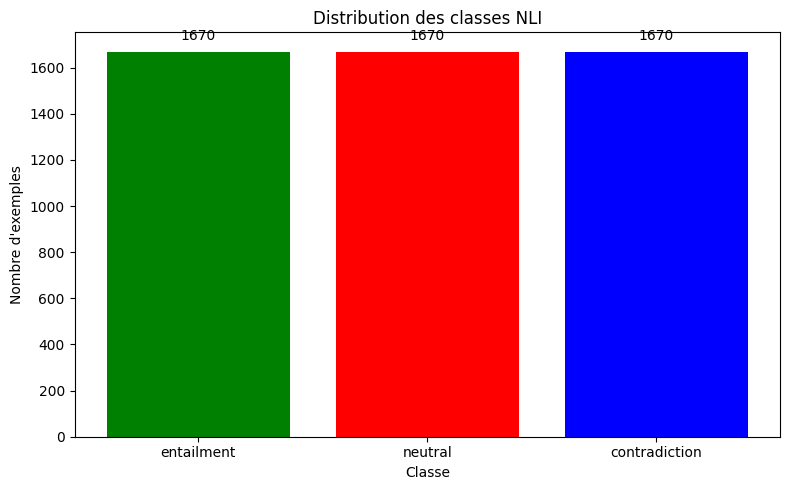
# Distribution des labels
print("\n Distribution des labels:")
label_counts = train_df.group_by(LABEL_COL).len().sort("len", descending=True)
print(label_counts)

# Visualisation
fig, ax = plt.subplots(figsize=(8, 5))
labels = label_counts[LABEL_COL].to_list()
counts = label_counts["len"].to_list()
colors = ["green", "red", "blue"]
ax.bar(labels, counts, color=colors[: len(labels)])
ax.set_title("Distribution des classes NLI")
ax.set_xlabel("Classe")
ax.set_ylabel("Nombre d'exemples")
for i, (label, count) in enumerate(zip(labels, counts)):
    ax.text(i, count + 50, str(count), ha="center", fontsize=10)
plt.tight_layout()
plt.show()
 Distribution des labels:
shape: (3, 2)
┌───────────────┬──────┐
│ label         ┆ len  │
│ ---           ┆ ---  │
│ str           ┆ u32  │
╞═══════════════╪══════╡
│ entailment    ┆ 1670 │
│ neutral       ┆ 1670 │
│ contradiction ┆ 1670 │
└───────────────┴──────┘
3. Configuration et Dataset PyTorch
# Mapping des labels
LABEL2ID = {"entailment": 0, "neutral": 1, "contradiction": 2}
ID2LABEL = {0: "entailment", 1: "neutral", 2: "contradiction"}
NUM_LABELS = 3

# Hyperparamètres
MAX_LENGTH = 128
BATCH_SIZE = 32
LEARNING_RATE = 2e-4
NUM_EPOCHS = 10
WEIGHT_DECAY = 0.01

# Configuration LoRA
LORA_R = 8
LORA_ALPHA = 32
LORA_DROPOUT = 0.1

print("Configuration définie")
Configuration définie
class NLIDataset(Dataset):
    """
    Dataset PyTorch pour NLI.

    Remplace HuggingFace datasets (incompatible avec pyarrow).
    Charge les données via Polars et tokenize.
    """

    def __init__(self, df: pl.DataFrame, tokenizer, max_length: int = 128):
        # Extraction des données en listes Python (plus rapide que accès DataFrame)
        self.premises = df[PREMISE_COL].to_list()
        self.hypotheses = df[HYPOTHESIS_COL].to_list()
        self.labels = df[LABEL_COL].to_list()

        self.tokenizer = tokenizer
        self.max_length = max_length

    def __len__(self):
        return len(self.labels)

    def __getitem__(self, idx):
        encoding = self.tokenizer(
            self.premises[idx],
            self.hypotheses[idx],
            truncation=True,
            max_length=self.max_length,
            padding="max_length",
            return_tensors="pt",
        )

        # Conversion du label
        label = self.labels[idx]
        if isinstance(label, str):
            label = LABEL2ID[label]

        return {
            "input_ids": encoding["input_ids"].squeeze(0),
            "attention_mask": encoding["attention_mask"].squeeze(0),
            "labels": torch.tensor(label, dtype=torch.long),
        }


print("Classe NLIDataset définie")
Classe NLIDataset définie
4. Fonctions Utilitaires
# Charger les métriques
accuracy_metric = evaluate.load("accuracy")
f1_metric = evaluate.load("f1")


def compute_metrics(eval_pred):
    """
    Calcule accuracy et F1 scores.
    """
    logits, labels = eval_pred
    predictions = np.argmax(logits, axis=-1)

    acc = accuracy_metric.compute(predictions=predictions, references=labels)
    f1_macro = f1_metric.compute(
        predictions=predictions, references=labels, average="macro"
    )
    f1_weighted = f1_metric.compute(
        predictions=predictions, references=labels, average="weighted"
    )

    return {
        "accuracy": acc["accuracy"],
        "f1_macro": f1_macro["f1"],
        "f1_weighted": f1_weighted["f1"],
    }


def plot_confusion_matrix(trainer, eval_dataset, class_names):
    """
    Affiche la matrice de confusion.
    """
    predictions = trainer.predict(eval_dataset)
    preds = np.argmax(predictions.predictions, axis=-1)
    labels = predictions.label_ids

    cm = confusion_matrix(labels, preds)

    plt.figure(figsize=(8, 6))
    sns.heatmap(
        cm,
        annot=True,
        fmt="d",
        cmap="Blues",
        xticklabels=class_names,
        yticklabels=class_names,
    )
    plt.xlabel("Prédiction")
    plt.ylabel("Vérité")
    plt.title("Matrice de Confusion")
    plt.tight_layout()
    plt.show()

    print("\n Rapport de classification:")
    print(classification_report(labels, preds, target_names=class_names))


def plot_training_history(log_history):
    """
    Visualise l'évolution de la loss et des métriques.
    """
    train_loss = [x["loss"] for x in log_history if "loss" in x]
    eval_data = [x for x in log_history if "eval_loss" in x]
    eval_loss = [x["eval_loss"] for x in eval_data]
    eval_acc = [x["eval_accuracy"] for x in eval_data]
    eval_f1 = [x.get("eval_f1_macro", 0) for x in eval_data]
    epochs = list(range(1, len(eval_loss) + 1))

    fig, axes = plt.subplots(1, 3, figsize=(15, 4))

    # Loss
    axes[0].plot(epochs, eval_loss, "b-o", label="Eval Loss")
    axes[0].set_xlabel("Epoch")
    axes[0].set_ylabel("Loss")
    axes[0].set_title("Évolution de la Loss")
    axes[0].legend()
    axes[0].grid(True, alpha=0.3)

    # Accuracy
    axes[1].plot(epochs, eval_acc, "g-o", label="Accuracy")
    axes[1].set_xlabel("Epoch")
    axes[1].set_ylabel("Accuracy")
    axes[1].set_title("Évolution de l'Accuracy")
    axes[1].legend()
    axes[1].grid(True, alpha=0.3)

    # F1 Score
    axes[2].plot(epochs, eval_f1, "r-o", label="F1 Macro")
    axes[2].set_xlabel("Epoch")
    axes[2].set_ylabel("F1 Score")
    axes[2].set_title("Évolution du F1 Score")
    axes[2].legend()
    axes[2].grid(True, alpha=0.3)

    plt.tight_layout()
    plt.show()


print("Fonctions utilitaires définies")Fonctions utilitaires définies
5. Modèle 1 : CamemBERT-base + LoRA
CamemBERT est basé sur l’architecture RoBERTa, pré-entraîné sur un corpus français de 138 Go (OSCAR).
5.1 Préparation
MODEL_1_NAME = "almanach/camembert-base"

print(f"Chargement du tokenizer {MODEL_1_NAME}...")
tokenizer_1 = AutoTokenizer.from_pretrained(MODEL_1_NAME)

print("Création des datasets...")
train_dataset_1 = NLIDataset(train_df, tokenizer_1, MAX_LENGTH)
test_dataset_1 = NLIDataset(test_df, tokenizer_1, MAX_LENGTH)

print(f"Train: {len(train_dataset_1)} exemples")
print(f"Test: {len(test_dataset_1)} exemples")
Chargement du tokenizer almanach/camembert-base...
Création des datasets...
Train: 5010 exemples
Test: 2490 exemples
# Vérification d'un exemple
sample = train_dataset_1[0]
print("Exemple tokenisé:")
print(f"  input_ids shape: {sample['input_ids'].shape}")
print(f"  attention_mask shape: {sample['attention_mask'].shape}")
print(f"  label: {sample['labels']} ({ID2LABEL[sample['labels'].item()]})")
Exemple tokenisé:
input_ids shape: torch.Size([128])
attention_mask shape: torch.Size([128])
label: 2 (contradiction)
5.2 Modèle et LoRA
print(f"Chargement du modèle {MODEL_1_NAME}...")
model_1 = AutoModelForSequenceClassification.from_pretrained(
    MODEL_1_NAME, num_labels=NUM_LABELS, id2label=ID2LABEL, label2id=LABEL2ID
)

# Configuration LoRA pour CamemBERT (architecture RoBERTa)
lora_config_1 = LoraConfig(
    task_type=TaskType.SEQ_CLS,
    inference_mode=False,
    r=LORA_R,
    lora_alpha=LORA_ALPHA,
    lora_dropout=LORA_DROPOUT,
    target_modules=["query", "value"],  # Architecture RoBERTa
)

model_1 = get_peft_model(model_1, lora_config_1)

print("\nParamètres entraînables:")
model_1.print_trainable_parameters()
Chargement du modèle almanach/camembert-base...
Some weights of CamembertForSequenceClassification were not initialized from the model checkpoint at almanach/camembert-base and are newly initialized: ['classifier.dense.bias', 'classifier.dense.weight', 'classifier.out_proj.bias', 'classifier.out_proj.weight']
You should probably TRAIN this model on a down-stream task to be able to use it for predictions and inference.
Paramètres entraînables:
trainable params: 887,811 || all params: 111,512,070 || trainable%: 0.7962
5.3 Entraînement
training_args_1 = TrainingArguments(
    output_dir="./results_camembert",
    learning_rate=LEARNING_RATE,
    per_device_train_batch_size=BATCH_SIZE,
    per_device_eval_batch_size=BATCH_SIZE,
    num_train_epochs=NUM_EPOCHS,
    weight_decay=WEIGHT_DECAY,
    eval_strategy="epoch",
    save_strategy="epoch",
    load_best_model_at_end=True,
    metric_for_best_model="f1_macro",
    greater_is_better=True,
    fp16=torch.cuda.is_available(),
    logging_steps=50,
    seed=SEED,
    report_to="none",
    dataloader_num_workers=2,
)

trainer_1 = Trainer(
    model=model_1,
    args=training_args_1,
    train_dataset=train_dataset_1,
    eval_dataset=test_dataset_1,
    compute_metrics=compute_metrics,
    callbacks=[EarlyStoppingCallback(early_stopping_patience=3)],
)

print("Trainer configuré")
Trainer configuré
print("Lancement de l'entraînement CamemBERT + LoRA...")
print("=" * 60)
trainer_1.train()
Lancement de l'entraînement CamemBERT + LoRA...
============================================================
/usr/local/lib/python3.12/dist-packages/torch/nn/parallel/_functions.py:71: UserWarning: Was asked to gather along dimension 0, but all input tensors were scalars; will instead unsqueeze and return a vector.
  warnings.warn(
/usr/local/lib/python3.12/dist-packages/torch/nn/parallel/_functions.py:71: UserWarning: Was asked to gather along dimension 0, but all input tensors were scalars; will instead unsqueeze and return a vector.
  warnings.warn(
/usr/local/lib/python3.12/dist-packages/torch/nn/parallel/_functions.py:71: UserWarning: Was asked to gather along dimension 0, but all input tensors were scalars; will instead unsqueeze and return a vector.
  warnings.warn(
/usr/local/lib/python3.12/dist-packages/torch/nn/parallel/_functions.py:71: UserWarning: Was asked to gather along dimension 0, but all input tensors were scalars; will instead unsqueeze and return a vector.
  warnings.warn(
/usr/local/lib/python3.12/dist-packages/torch/nn/parallel/_functions.py:71: UserWarning: Was asked to gather along dimension 0, but all input tensors were scalars; will instead unsqueeze and return a vector.
  warnings.warn(
/usr/local/lib/python3.12/dist-packages/torch/nn/parallel/_functions.py:71: UserWarning: Was asked to gather along dimension 0, but all input tensors were scalars; will instead unsqueeze and return a vector.
  warnings.warn(
/usr/local/lib/python3.12/dist-packages/torch/nn/parallel/_functions.py:71: UserWarning: Was asked to gather along dimension 0, but all input tensors were scalars; will instead unsqueeze and return a vector.
  warnings.warn(
/usr/local/lib/python3.12/dist-packages/torch/nn/parallel/_functions.py:71: UserWarning: Was asked to gather along dimension 0, but all input tensors were scalars; will instead unsqueeze and return a vector.
  warnings.warn(
/usr/local/lib/python3.12/dist-packages/torch/nn/parallel/_functions.py:71: UserWarning: Was asked to gather along dimension 0, but all input tensors were scalars; will instead unsqueeze and return a vector.
  warnings.warn(
/usr/local/lib/python3.12/dist-packages/torch/nn/parallel/_functions.py:71: UserWarning: Was asked to gather along dimension 0, but all input tensors were scalars; will instead unsqueeze and return a vector.
  warnings.warn(
TrainOutput(global_step=790, training_loss=0.717345510555219, metrics={'train_runtime': 550.8198, 'train_samples_per_second': 90.955, 'train_steps_per_second': 1.434, 'total_flos': 3329655683328000.0, 'train_loss': 0.717345510555219, 'epoch': 10.0})5.4 Évaluation
print("Évaluation finale CamemBERT:")
results_1 = trainer_1.evaluate()
print(f"  Accuracy: {results_1['eval_accuracy']:.4f}")
print(f"  F1 Macro: {results_1['eval_f1_macro']:.4f}")
print(f"  F1 Weighted: {results_1['eval_f1_weighted']:.4f}")
print(f"  Loss: {results_1['eval_loss']:.4f}")
Évaluation finale CamemBERT:
/usr/local/lib/python3.12/dist-packages/torch/nn/parallel/_functions.py:71: UserWarning: Was asked to gather along dimension 0, but all input tensors were scalars; will instead unsqueeze and return a vector.
  warnings.warn(
  Accuracy: 0.7273
  F1 Macro: 0.7273
  F1 Weighted: 0.7273
  Loss: 0.6738
# Visualisations
plot_training_history(trainer_1.state.log_history)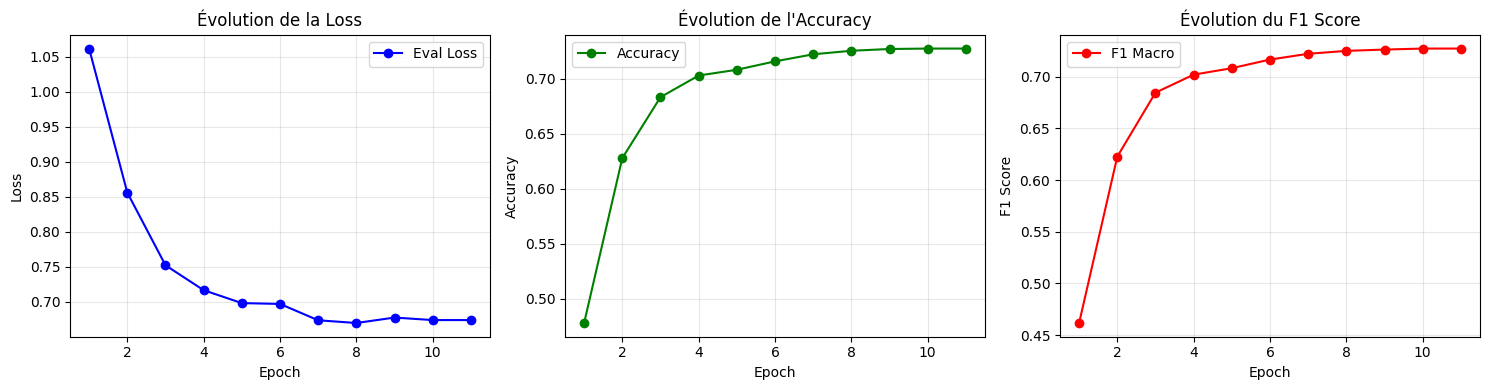
plot_confusion_matrix(trainer_1, test_dataset_1, list(LABEL2ID.keys()))/usr/local/lib/python3.12/dist-packages/torch/nn/parallel/_functions.py:71: UserWarning: Was asked to gather along dimension 0, but all input tensors were scalars; will instead unsqueeze and return a vector.
warnings.warn(
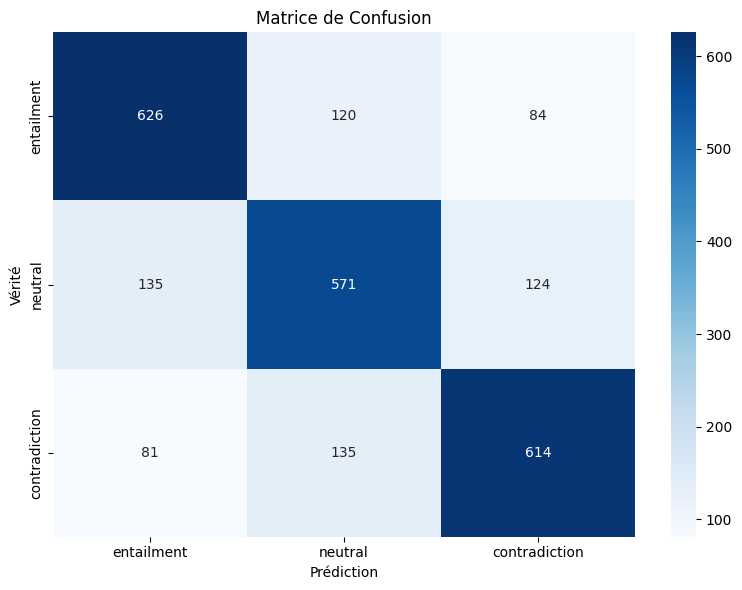
Rapport de classification:
precision recall f1-score support
entailment 0.74 0.75 0.75 830
neutral 0.69 0.69 0.69 830
contradiction 0.75 0.74 0.74 830
accuracy 0.73 2490
macro avg 0.73 0.73 0.73 2490
weighted avg 0.73 0.73 0.73 2490
6. Modèle 2 : CamemBERTa-base + LoRA
CamemBERTa est basé sur l’architecture DeBERTa-v2, qui intègre des améliorations comme le disentangled attention et un enhanced mask decoder.
6.1 Préparation
MODEL_2_NAME = "almanach/camemberta-base"
print(f"Chargement du tokenizer {MODEL_2_NAME}...")
tokenizer_2 = AutoTokenizer.from_pretrained(MODEL_2_NAME)
print("Création des datasets...")
train_dataset_2 = NLIDataset(train_df, tokenizer_2, MAX_LENGTH)
test_dataset_2 = NLIDataset(test_df, tokenizer_2, MAX_LENGTH)
print(f"Train: {len(train_dataset_2)} exemples")
print(f"Test: {len(test_dataset_2)} exemples")Chargement du tokenizer almanach/camemberta-base...
Création des datasets...
Train: 5010 exemples
Test: 2490 exemples
6.2 Modèle et LoRA
print(f"Chargement du modèle {MODEL_2_NAME}...")
model_2 = AutoModelForSequenceClassification.from_pretrained(
MODEL_2_NAME, num_labels=NUM_LABELS, id2label=ID2LABEL, label2id=LABEL2ID
)
# Configuration LoRA pour CamemBERTa (architecture DeBERTa-v2)
# Les modules d'attention utilisent "query_proj" et "value_proj"
lora_config_2 = LoraConfig(
task_type=TaskType.SEQ_CLS,
inference_mode=False,
r=LORA_R,
lora_alpha=LORA_ALPHA,
lora_dropout=LORA_DROPOUT,
target_modules=["query_proj", "value_proj"], # Architecture DeBERTa
)
model_2 = get_peft_model(model_2, lora_config_2)
print("Paramètres entraînables:")
model_2.print_trainable_parameters()Chargement du modèle almanach/camemberta-base...
Some weights of DebertaV2ForSequenceClassification were not initialized from the model checkpoint at almanach/camemberta-base and are newly initialized: ['classifier.bias', 'classifier.weight', 'pooler.dense.bias', 'pooler.dense.weight']
You should probably TRAIN this model on a down-stream task to be able to use it for predictions and inference.
Paramètres entraînables:
trainable params: 297,219 || all params: 112,694,790 || trainable%: 0.2637
6.3 Entraînement
training_args_2 = TrainingArguments(
output_dir="./results_camemberta",
learning_rate=LEARNING_RATE,
per_device_train_batch_size=BATCH_SIZE,
per_device_eval_batch_size=BATCH_SIZE,
num_train_epochs=NUM_EPOCHS,
weight_decay=WEIGHT_DECAY,
eval_strategy="epoch",
save_strategy="epoch",
load_best_model_at_end=True,
metric_for_best_model="f1_macro",
greater_is_better=True,
fp16=torch.cuda.is_available(),
logging_steps=50,
seed=SEED,
report_to="none",
dataloader_num_workers=2,
)
trainer_2 = Trainer(
model=model_2,
args=training_args_2,
train_dataset=train_dataset_2,
eval_dataset=test_dataset_2,
compute_metrics=compute_metrics,
callbacks=[EarlyStoppingCallback(early_stopping_patience=3)],
)
print("Trainer configuré")Trainer configuré
print("Lancement de l'entraînement CamemBERTa + LoRA...")
print("=" * 60)
trainer_2.train()Lancement de l'entraînement CamemBERTa + LoRA...
============================================================
/usr/local/lib/python3.12/dist-packages/torch/nn/parallel/_functions.py:71: UserWarning: Was asked to gather along dimension 0, but all input tensors were scalars; will instead unsqueeze and return a vector.
  warnings.warn(
/usr/local/lib/python3.12/dist-packages/torch/nn/parallel/_functions.py:71: UserWarning: Was asked to gather along dimension 0, but all input tensors were scalars; will instead unsqueeze and return a vector.
  warnings.warn(
/usr/local/lib/python3.12/dist-packages/torch/nn/parallel/_functions.py:71: UserWarning: Was asked to gather along dimension 0, but all input tensors were scalars; will instead unsqueeze and return a vector.
warnings.warn(
/usr/local/lib/python3.12/dist-packages/torch/nn/parallel/_functions.py:71: UserWarning: Was asked to gather along dimension 0, but all input tensors were scalars; will instead unsqueeze and return a vector.
warnings.warn(
/usr/local/lib/python3.12/dist-packages/torch/nn/parallel/_functions.py:71: UserWarning: Was asked to gather along dimension 0, but all input tensors were scalars; will instead unsqueeze and return a vector.
warnings.warn(
/usr/local/lib/python3.12/dist-packages/torch/nn/parallel/_functions.py:71: UserWarning: Was asked to gather along dimension 0, but all input tensors were scalars; will instead unsqueeze and return a vector.
warnings.warn(
/usr/local/lib/python3.12/dist-packages/torch/nn/parallel/_functions.py:71: UserWarning: Was asked to gather along dimension 0, but all input tensors were scalars; will instead unsqueeze and return a vector.
warnings.warn(
/usr/local/lib/python3.12/dist-packages/torch/nn/parallel/_functions.py:71: UserWarning: Was asked to gather along dimension 0, but all input tensors were scalars; will instead unsqueeze and return a vector.
warnings.warn(
/usr/local/lib/python3.12/dist-packages/torch/nn/parallel/_functions.py:71: UserWarning: Was asked to gather along dimension 0, but all input tensors were scalars; will instead unsqueeze and return a vector.
warnings.warn(
/usr/local/lib/python3.12/dist-packages/torch/nn/parallel/_functions.py:71: UserWarning: Was asked to gather along dimension 0, but all input tensors were scalars; will instead unsqueeze and return a vector.
warnings.warn(
TrainOutput(global_step=790, training_loss=0.4492081907731068, metrics={'train_runtime': 738.4261, 'train_samples_per_second': 67.847, 'train_steps_per_second': 1.07, 'total_flos': 3375162964224000.0, 'train_loss': 0.4492081907731068, 'epoch': 10.0})6.4 Évaluation
print("Évaluation finale CamemBERTa:")
results_2 = trainer_2.evaluate()
print(f"  Accuracy: {results_2['eval_accuracy']:.4f}")
print(f"  F1 Macro: {results_2['eval_f1_macro']:.4f}")
print(f"  F1 Weighted: {results_2['eval_f1_weighted']:.4f}")
print(f"  Loss: {results_2['eval_loss']:.4f}")
Évaluation finale CamemBERTa:
/usr/local/lib/python3.12/dist-packages/torch/nn/parallel/_functions.py:71: UserWarning: Was asked to gather along dimension 0, but all input tensors were scalars; will instead unsqueeze and return a vector.
  warnings.warn(
  Accuracy: 0.7598
  F1 Macro: 0.7598
  F1 Weighted: 0.7598
  Loss: 0.6853
plot_training_history(trainer_2.state.log_history)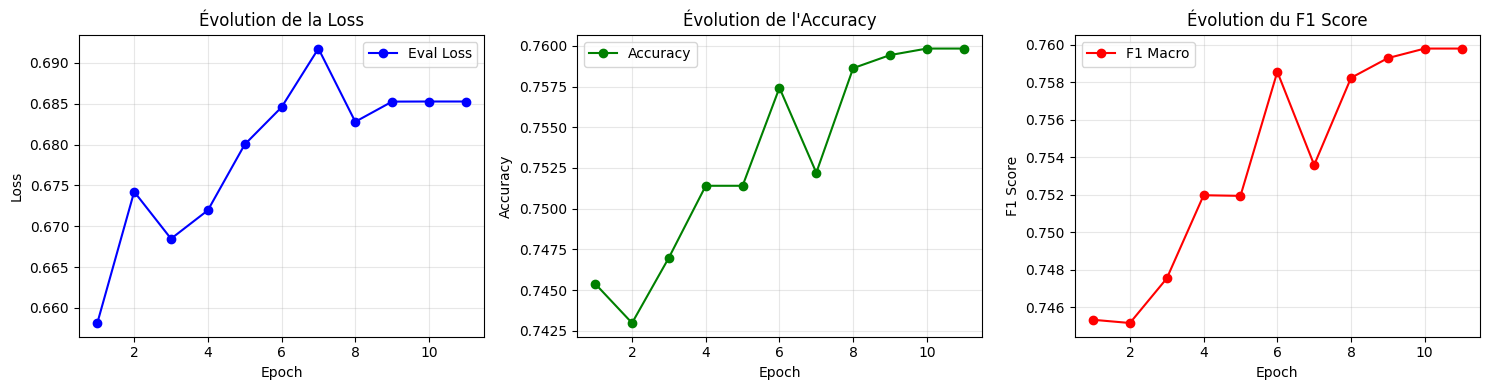
plot_confusion_matrix(trainer_2, test_dataset_2, list(LABEL2ID.keys()))/usr/local/lib/python3.12/dist-packages/torch/nn/parallel/_functions.py:71: UserWarning: Was asked to gather along dimension 0, but all input tensors were scalars; will instead unsqueeze and return a vector.
warnings.warn(
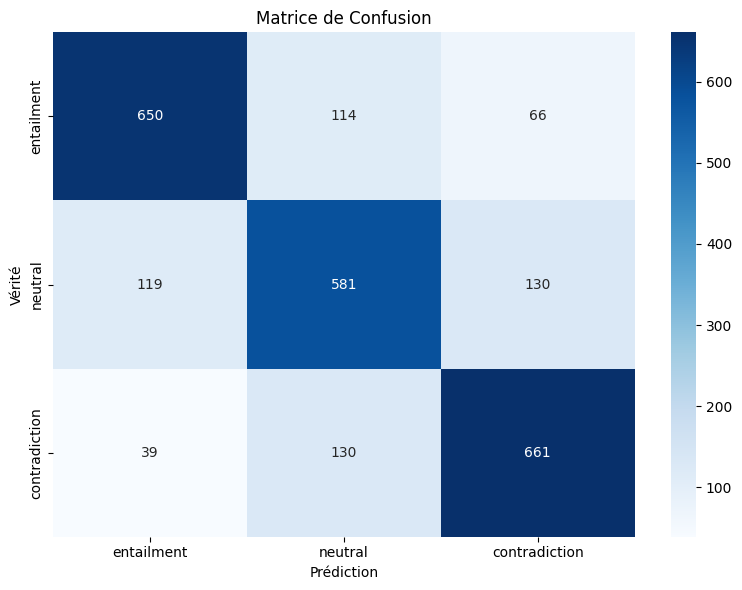
 Rapport de classification:
               precision    recall  f1-score   support

   entailment       0.80      0.78      0.79       830
      neutral       0.70      0.70      0.70       830
contradiction       0.77      0.80      0.78       830

     accuracy                           0.76      2490
    macro avg       0.76      0.76      0.76      2490
 weighted avg       0.76      0.76      0.76      2490
7. Comparaison des Modèles
# Tableau comparatif
comparison_data = {
    "Modèle": ["CamemBERT-base", "CamemBERTa-base"],
    "Architecture": ["RoBERTa", "DeBERTa-v2"],
    "Accuracy": [results_1["eval_accuracy"], results_2["eval_accuracy"]],
    "F1 Macro": [results_1["eval_f1_macro"], results_2["eval_f1_macro"]],
    "F1 Weighted": [results_1["eval_f1_weighted"], results_2["eval_f1_weighted"]],
    "Loss": [results_1["eval_loss"], results_2["eval_loss"]],
}

comparison_df = pl.DataFrame(comparison_data)

print("\n" + "=" * 70)
print("COMPARAISON DES MODÈLES")
print("=" * 70)
print(comparison_df)
======================================================================
COMPARAISON DES MODÈLES
======================================================================
shape: (2, 6)
┌─────────────────┬──────────────┬──────────┬──────────┬─────────────┬──────────┐
│ Modèle          ┆ Architecture ┆ Accuracy ┆ F1 Macro ┆ F1 Weighted ┆ Loss     │
│ ---             ┆ ---          ┆ ---      ┆ ---      ┆ ---         ┆ ---      │
│ str             ┆ str          ┆ f64      ┆ f64      ┆ f64         ┆ f64      │
╞═════════════════╪══════════════╪══════════╪══════════╪═════════════╪══════════╡
│ CamemBERT-base  ┆ RoBERTa      ┆ 0.727309 ┆ 0.727253 ┆ 0.727253    ┆ 0.673848 │
│ CamemBERTa-base ┆ DeBERTa-v2   ┆ 0.759839 ┆ 0.759802 ┆ 0.759802    ┆ 0.685278 │
└─────────────────┴──────────────┴──────────┴──────────┴─────────────┴──────────┘
# Visualisation comparative
fig, ax = plt.subplots(figsize=(10, 6))

x = np.arange(3)
width = 0.35

metrics = ["Accuracy", "F1 Macro", "F1 Weighted"]
camembert_scores = [
    results_1["eval_accuracy"],
    results_1["eval_f1_macro"],
    results_1["eval_f1_weighted"],
]
camemberta_scores = [
    results_2["eval_accuracy"],
    results_2["eval_f1_macro"],
    results_2["eval_f1_weighted"],
]

bars1 = ax.bar(
    x - width / 2, camembert_scores, width, label="CamemBERT", color="#3498db"
)
bars2 = ax.bar(
    x + width / 2, camemberta_scores, width, label="CamemBERTa", color="#e74c3c"
)

ax.set_ylabel("Score")
ax.set_title("Comparaison des performances NLI - CamemBERT vs CamemBERTa")
ax.set_xticks(x)
ax.set_xticklabels(metrics)
ax.legend()
ax.set_ylim(0, 1)
ax.grid(True, alpha=0.3, axis="y")

# Valeurs sur les barres
for bars in [bars1, bars2]:
    for bar in bars:
        height = bar.get_height()
        ax.annotate(
            f"{height:.3f}",
            xy=(bar.get_x() + bar.get_width() / 2, height),
            xytext=(0, 3),
            textcoords="offset points",
            ha="center",
            va="bottom",
            fontsize=9,
        )

plt.tight_layout()
plt.show()

# Déterminer le gagnant
winner = (
    "CamemBERT"
    if results_1["eval_f1_macro"] > results_2["eval_f1_macro"]
    else "CamemBERTa"
)
print(f"\n🏆 Meilleur modèle (F1 Macro): {winner}")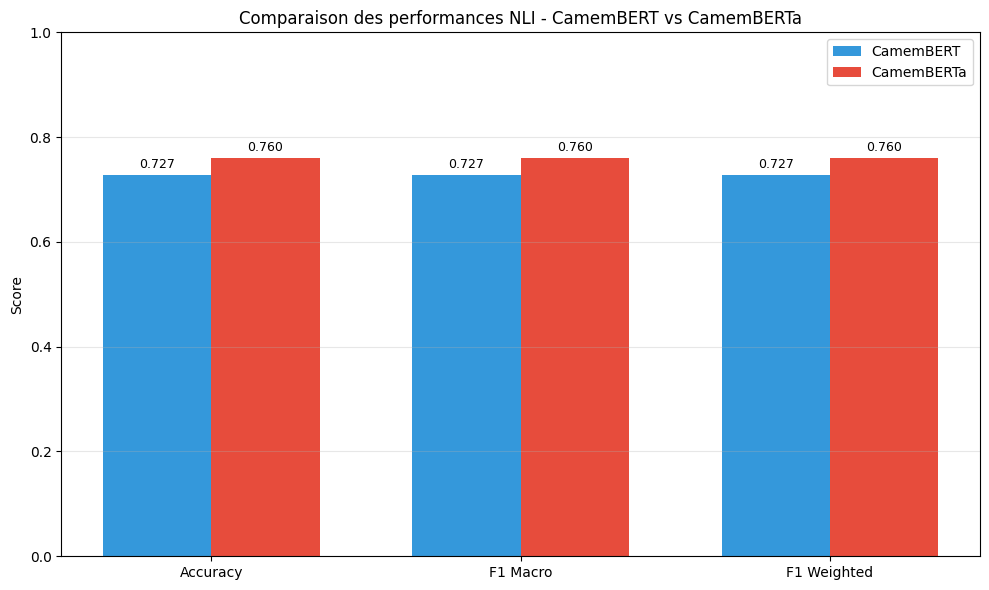
🏆 Meilleur modèle (F1 Macro): CamemBERTa
# Sélection du meilleur modèle
if results_1["eval_f1_macro"] > results_2["eval_f1_macro"]:
    best_model = model_1
    best_tokenizer = tokenizer_1
    best_name = "CamemBERT"
    best_results = results_1
else:
    best_model = model_2
    best_tokenizer = tokenizer_2
    best_name = "CamemBERTa"
    best_results = results_2

print(f"Meilleur modèle: {best_name}")
print(f"   F1 Macro: {best_results['eval_f1_macro']:.4f}")
print(f"   Accuracy: {best_results['eval_accuracy']:.4f}")

# Sauvegarde
SAVE_PATH = "./best_model_nli_fr"
best_model.save_pretrained(SAVE_PATH)
best_tokenizer.save_pretrained(SAVE_PATH)
print(f"Modèle sauvegardé dans {SAVE_PATH}")
Meilleur modèle: CamemBERTa
F1 Macro: 0.7598
Accuracy: 0.7598
Modèle sauvegardé dans ./best_model_nli_fr
9. Inférence
def predict_nli(premise: str, hypothesis: str, model, tokenizer):
    """
    Prédit la relation NLI entre une prémisse et une hypothèse.

    Returns:
        dict avec 'prediction' et 'probabilities'
    """
    model.eval()
    device = next(model.parameters()).device

    inputs = tokenizer(
        premise,
        hypothesis,
        return_tensors="pt",
        truncation=True,
        max_length=MAX_LENGTH,
        padding=True,
    )
    inputs = {k: v.to(device) for k, v in inputs.items()}

    with torch.no_grad():
        outputs = model(**inputs)
        probs = torch.softmax(outputs.logits, dim=-1)
        prediction = torch.argmax(probs, dim=-1).item()

    return {
        "prediction": ID2LABEL[prediction],
        "confidence": probs[0][prediction].item(),
        "probabilities": {ID2LABEL[i]: prob.item() for i, prob in enumerate(probs[0])},
    }


def display_prediction(premise: str, hypothesis: str, model, tokenizer):
    """Affiche joliment une prédiction."""
    result = predict_nli(premise, hypothesis, model, tokenizer)

    print(f"   Prémisse: {premise}")
    print(f"   Hypothèse: {hypothesis}")
    print(
        f"\n  Prédiction: {result['prediction'].upper()} (confiance: {result['confidence']:.1%})"
    )
    print(f"\n  Probabilités:")
    for label, prob in result["probabilities"].items():
        bar = "█" * int(prob * 20)
        print(f"   {label:15} {bar} {prob:.1%}")
    print("-" * 60)
# Exemples de test
test_examples = [
# Entailment (l'hypothèse découle de la prémisse)
("Je suis étudiant en Master MIASHS à Lyon 2.", "Je fais des études supérieures."),
("J'habite à Lyon.", "Je vis en Europe."),
# Contradiction (l'hypothèse contredit la prémisse)
("Je suis en Master 2.", "Je suis en première année de licence."),
("J'habite à Lyon.", "J'habite à Marseille."),
# Neutral (pas de lien logique direct)
("Je fais le Master MIASHS.", "Je joue la guitarre."),
("J'aime le rock", "Je prends le tram tout les matins"),
]
print("\nEXEMPLES DE PRÉDICTION")
print("=" * 60)
for premise, hypothesis in test_examples:
display_prediction(premise, hypothesis, best_model, best_tokenizer)
print()
EXEMPLES DE PRÉDICTION
============================================================
   Prémisse: Je suis étudiant en Master MIASHS à Lyon 2.
   Hypothèse: Je fais des études supérieures.

  Prédiction: ENTAILMENT (confiance: 96.4%)

  Probabilités:
   entailment      ███████████████████ 96.4%
   neutral          2.5%
   contradiction    1.0%
------------------------------------------------------------

   Prémisse: J'habite à Lyon.
   Hypothèse: Je vis en Europe.

  Prédiction: NEUTRAL (confiance: 78.0%)

  Probabilités:
   entailment       3.2%
   neutral         ███████████████ 78.0%
   contradiction   ███ 18.8%
------------------------------------------------------------

   Prémisse: Je suis en Master 2.
   Hypothèse: Je suis en première année de licence.

  Prédiction: CONTRADICTION (confiance: 96.2%)

  Probabilités:
   entailment       1.6%
   neutral          2.2%
   contradiction   ███████████████████ 96.2%
------------------------------------------------------------

   Prémisse: J'habite à Lyon.
   Hypothèse: J'habite à Marseille.

  Prédiction: CONTRADICTION (confiance: 92.2%)

  Probabilités:
   entailment       2.3%
   neutral         █ 5.5%
   contradiction   ██████████████████ 92.2%
------------------------------------------------------------

   Prémisse: Je fais le Master MIASHS.
   Hypothèse: Je joue la guitarre.

  Prédiction: NEUTRAL (confiance: 56.7%)

  Probabilités:
   entailment      ███████ 39.5%
   neutral         ███████████ 56.7%
   contradiction    3.8%
------------------------------------------------------------

   Prémisse: J'aime le rock
   Hypothèse: Je prends le tram tout les matins

  Prédiction: NEUTRAL (confiance: 73.3%)

  Probabilités:
   entailment       1.4%
   neutral         ██████████████ 73.3%
   contradiction   █████ 25.3%
------------------------------------------------------------
Points clés techniques
Polars pour un chargement de données rapide, contournant les problèmes de compatibilité
pyarrow/datasetsDataset PyTorch custom pour une intégration flexible avec le Trainer HuggingFace
LoRA (r=8, α=32) : seulement ~0.26% des paramètres entraînés, permettant un fine-tuning sur GPU T4 (16 Go)
Early stopping (patience=3) pour prévenir l’overfitting
Limites observées
Lors des tests d’inférence, le modèle montre des difficultés sur :
Le raisonnement multi-étapes : “J’habite à Lyon” → “Je vis en Europe” prédit comme Neutral (alors que c’est un Entailment via Lyon → France → Europe)
Les cas Neutral ambigus avec confiance modérée (~57-73%) et avec une f1 scores plus petit que les autres (.70 contre .78 pour contradiction et .79 pour entailment)
Résultats
| Modèle | Accuracy | F1 Macro | F1 Weighted |
|---|---|---|---|
| CamemBERT | 72.73% | 72.73% | 72.73% |
| CamemBERTa | 75.98% | 75.98% | 75.98% |
🏆 Meilleur modèle : CamemBERTa avec un F1 Macro de 75.98%
Conclusion
Les résultats confirment que CamemBERTa obtient des performances supérieures à CamemBERT (+3%), ce qui est cohérent avec les avantages théoriques de l’architecture DeBERTa. Le mécanisme de disentangled attention et l’utilisation de positions relatives permettent une meilleure modélisation des relations entre les mots.
Le meilleur modèle, ici CamemBERTa a atteind environ 76% d’accuracy en n’entraînant que 0.26% des paramètres grâce à LoRA, ce qui démontre l’efficacité de cette méthode pour le fine-tuning de modèles de langage avec des ressources limitées. Un mécanisme d’early stopping (patience=3) était en place pour prévenir l’overfitting, bien que les modèles aient continué à s’améliorer sur les 10 epochs.