Main Concept
LLE transforms high-dimensional data into a lower-dimensional space while preserving the local geometry of the data. The key insight is that each data point and its neighbors lie approximately on a locally linear patch of the manifold.
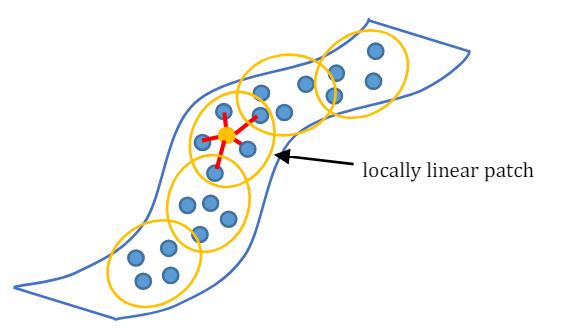
The transformation occurs in three main steps:
- For each point , find its nearest neighbors
- Compute weights that best reconstruct each point from its neighbors
- Find low-dimensional points that are reconstructed by the same weights
The transformation preserves local relationships while allowing the global structure to be unfolded into a lower-dimensional space.
Theoretical Aspect
LLE involves two separate optimization problems:
- Weight Computation: Subject to constraints:
- if is not a neighbor of
- for each
- Embedding Computation: Subject to constraints:
- (centered at origin)
- (unit covariance)
The key variables being optimized are:
- The weight matrix in the first step
- The low-dimensional coordinates in the second step
Solution Methodology
The algorithm follows these main steps:
Neighbor Search:
- Use k-nearest neighbors or ε-ball methods
- Typically employs efficient data structures like k-d trees
Weight Computation:
- Solve local linear systems for each point
- Can be expressed as:
- Solution involves solving a small linear system with the Gram matrix
Embedding Computation:
- The optimization reduces to an eigenvalue problem
- Find bottom eigenvectors of (excluding the zero eigenvalue)
- These eigenvectors provide the coordinates in the low-dimensional space
Global Optimality
The LLE algorithm has interesting optimality properties:
Weight Computation:
- This step is globally optimal for each local neighborhood
- The solution is obtained by solving a convex optimization problem
Embedding Computation:
- The final embedding step has a global solution
- It reduces to an eigenvalue problem which can be solved exactly
However, there are important limitations:
Local Minima Issues:
- The choice of neighbors affects the final solution
- Different neighborhood sizes can lead to different embeddings
Topological Limitations:
- Cannot handle cases where the manifold is not locally linear
- Struggles with holes or complex topological features
Conclusion
The key mathematical advantage of LLE over many other methods is its ability to reduce the dimensionality reduction problem to two sequential convex optimization problems, making it computationally efficient and theoretically well-grounded. However, its reliance on local linearity assumptions can be a limitation in practice.